
How to Get a Job With No Experience
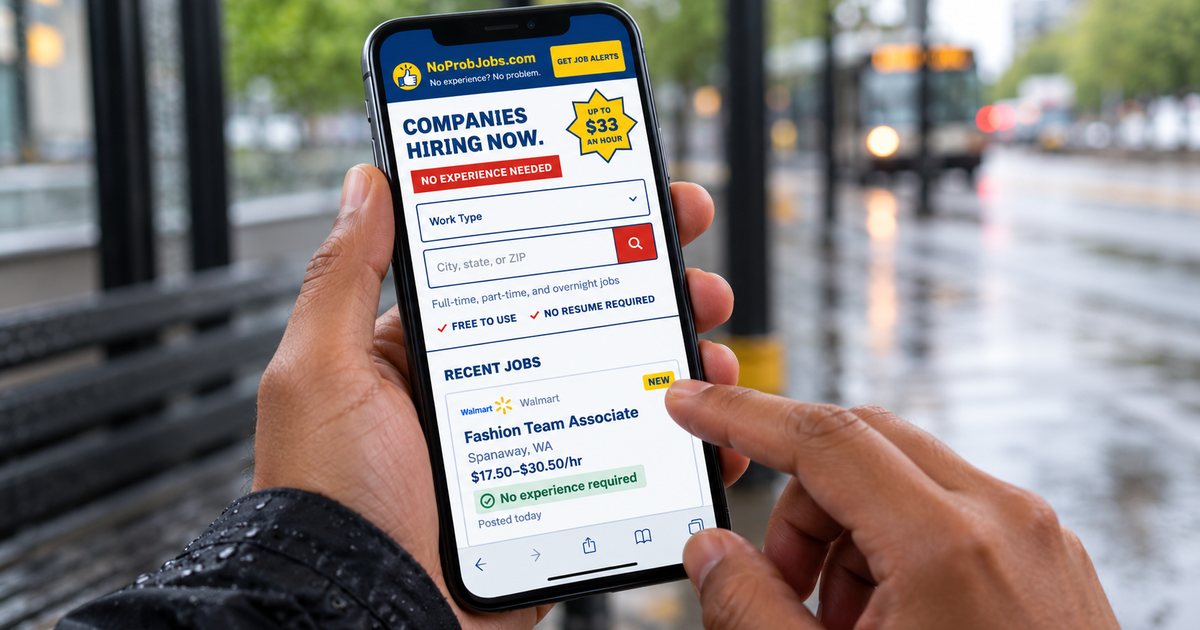
Plenty of employers hire people who have never held the job before. Stores, restaurants, warehouses, cleaning companies, security firms and hospitals all fill hourly roles with people they train on the job. Getting hired comes down to finding the postings that are actually open to beginners, applying to enough of them, and being easy to say yes to.
Why it can feel harder than it is
Across the U.S., unemployment is higher for people without a college degree. In August 2026, for workers 25 and older (U.S. Bureau of Labor Statistics):
| Education | Unemployment rate |
|---|---|
| Less than a high school diploma | 4.7% |
| High school graduate, no college | 4.4% |
| Some college or associate degree | 3.7% |
| Bachelor's degree and higher | 2.7% |
Entry-level openings have also shrunk. Entry-level job postings fell 7.5% in the year to May 2026, while senior-level postings rose 14.7% (Indeed Hiring Lab).
And more than 75 million U.S. workers built their skills through routes other than a bachelor's degree. Since 2000, they have lost access to 7.4 million higher-wage jobs (Opportunity@Work).
That doesn't mean you can't get hired. It means your time is best spent on jobs that are built to hire beginners, not jobs that quietly expect experience.
Where no-experience jobs are

Retail and grocery. Cashier, stocker, sales associate. The Bureau of Labor Statistics lists the typical entry-level education for retail sales workers as no formal educational credential, with no related work experience required.
Food service. Crew member, barista, dishwasher, prep cook. Some states and counties require a food handler card. Check your state or county health department for the rules where you live.
Warehouse and delivery. Picker, packer, loader, package handler. Most of the work is learned on the floor.
Cleaning and facilities. Janitor, custodian, housekeeper. Often early morning or overnight shifts.
Security. Unarmed security officer. Licensing rules vary by state. Some states require a license and short training course before you start.
Healthcare (non-clinical). Front desk, scheduling, hospital food service, cleaning, patient transport. These don't need a medical license. Roles like nursing assistant or medical assistant usually do.
How to read a posting in 30 seconds
Look for these phrases:
- "No experience required" or "no experience necessary"
- "Will train" or "we'll train you"
- "Paid training" in the job description or requirements
If "paid training" only shows up in a benefits list at the bottom, read the requirements too. Some employers paste the same perks list on every posting.
Required vs. preferred:
- Required means the employer expects it.
- Preferred means they'd like it but will hire without it.
"Experience preferred" is not "experience required." If you meet the required list, apply.
Steps that get you hired faster
- Pick two or three job types that fit your schedule and how you like to work.
- Search with the right words. "No experience" or "will train" plus the job type and your city.
- Check the pay. The federal minimum wage is $7.25 an hour, but 30 states and Washington, D.C. set a higher minimum. Employers have to pay whichever is higher where the job is.
- Fill out applications completely, especially availability. Hourly employers often care about your schedule most.
- List what you've done, even unpaid: volunteering, babysitting, yard work, helping with a family business, school programs.
- Apply to several jobs the same day. Newer postings get the most attention.
- Answer your phone and check texts. Hourly employers often reach out fast to set up interviews.
- Show up on time. For many of these jobs, reliability is what employers are looking for most.
Where to find jobs
NoProbJobs lists jobs that hire without experience or will train you:
Sources
- U.S. Bureau of Labor Statistics, "Unemployment rate for people with less than a high school diploma was 4.7 percent in August 2026," The Economics Daily.
- Indeed Hiring Lab, "The Labor Market Is Tilting Toward Seniority," July 23, 2026.
- Opportunity@Work, State of the Paper Ceiling.
- U.S. Bureau of Labor Statistics, Occupational Outlook Handbook, Retail Sales Workers.
- U.S. Department of Labor, State Minimum Wage Laws.